
Germany: Court ruling on EC dispensing

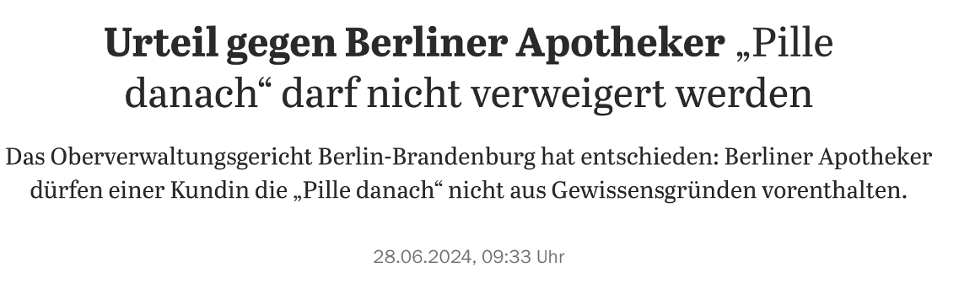
June 2024. In Germany, the Berlin-Brandenburg Higher Administrative Court ruled that a pharmacist cannot refuse dispensing emergency contraceptive pills (ECPs) because of his or her beliefs or “conscience”.

The Berlin Pharmacist Chamber had initiated a process against a pharmacist who systematically refused to stock and dispense ECPs in his pharmacy because he believed ECPs could “end a life”.  The Court ruling clarifies that ECPs “only delay or prevent ovulation”, and that “anyone who decides to run a public pharmacy must ensure comprehensive care”.

Read more here: https://www.tagesspiegel.de/berlin/prozess-gericht-apotheker-darf-pille-danach-nicht-verweigern-11917430.html

Similar Posts

  • |

    An update on access to EC in Europe: New publication by ECEC

    February 2022. Since 2012, the European Consortium for Emergency Contraception (ECEC) monitors emergency contraception (EC) availability and accessibility in Europe, and maintains a country-by-country database to generate and disseminate knowledge. This open-access database is regularly updated thanks to the collaboration of partners and local experts to whom we want to express our deepest gratitude. ECEC…

  • Review of uses of UPA beyond EC

    March 2025. A new article describes uses of ulipristal acetate (UPA) beyond emergency contraception: Uses of ulipristal acetate beyond emergency contraception: a narrative review (Ebersole, Ashley M. et al. Contraception). The review describes the extensive potential for UPA to treat and/or prevent conditions such as fibroids, breast cancer, and abnormal uterine bleeding, in addition to other…

  • UK: access to EC, coronavirus, and confidentiality

    November 2020. In September 2020, BPAS undertook a mystery shopper survey to assess whether and how pharmacies in the United Kingdom deliver the mandatory consultation for emergency contraception (EC) during the COVID-19 pandemic; and to assess whether and how easily women can access EHC without compromising on social distancing practices. In the UK EC can…

  • EMA recommends double dose of LNG EC when used with enzyme-inducers

    On May 2016, the European Medicines Agency (EMA) recommended the use of a non-hormonal emergency contraceptive (EC) when a woman in need of EC is using other interacting medicines (such as the HIV medicine efavirenz and ritonavir, certain medicines for tuberculosis and epilepsy, and herbal medicines containing St John’s wort). If using a cooper IUD…

  • Argentina: New data on EC use and access

    November 2024. The Study Lucía: Uses and preferences of contraceptive methods in women aged 15 to 49 years in Argentina, was recently published. This quantitative and qualitative research has consulted 2,000 women and people identifyin as LGTB from all over the nation. The study findings, published in September 2024, include valuable information about access to…

  • Pericoital contraception in the State of Self-Care Report 2025

    April 2026. The latest State of Self-Care Report 2025 highlights growing interest in new, user-controlled contraceptive options, including pericoital (on-demand) pills. Two case studies from Malawi, Kenya, and Uganda provide valuable insights into how women and adolescent girls perceive these methods and the potential role they could play in expanding contraceptive choice. Summary of findings:…