
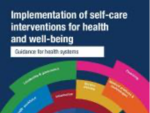
Self-care interventions: guidance for health systems.

July 2024.  The World Health Organization (WHO)/HRP just published Implementation of self-care interventions for health and well-being: guidance for health systems. Aimed at those around the world implementing self-care interventions, the publication reviews WHO’s six health systems building blocks, and looks at the implementation considerations necessary for each. Several country case studies are also included.

To read more about the guidance visit the WHO website here. You can also download the document here.  To read more about WHO recommendations on making EC pills available without a prescription, go here.
Similar Posts

  • Council of Europe: Historic resolution on contraception

    June 2020.  The Council of Europe’s Parliamentary Assembly (PACE) just adopted Resolution 2331 (2020) “Empowering women: promoting access to contraception in Europe”.  It is the first time in its history that the parliamentary body of the Council of Europe provides recommendations in a Resolution entirely dedicated to improving access to contraception in Europe. Among others,…

  • Update on UPA in European Union countries – May 2015

    In January 2015 the European Commission issued an implementing decision, amending the marketing authorisation granted in 2009 for UPA ECPs. Sine then, the decision has started to be implemented. In most European Union countries the decision is being followed and UPA ECPs are available directly in the pharmacies or will be very soon. At the…

  • Japan:  Trial of OTC sale of ECPs begins 

    November. According to Kyodo news agency, the trial of a new modality to dispense  emergency contraception pills (ECPs) without a prescription in Japan, began on November 28. The Health, Labour and Welfare Ministry will test out this modality in 145 pharmacies (of more than 60.000 in the country). Japan is one of the few northern hemisphere countries where…

  • Argentina: New data on EC use and access

    November 2024. The Study Lucía: Uses and preferences of contraceptive methods in women aged 15 to 49 years in Argentina, was recently published. This quantitative and qualitative research has consulted 2,000 women and people identifyin as LGTB from all over the nation. The study findings, published in September 2024, include valuable information about access to…