WHO ECO guidelines recommend mifepristone for emergency contraception

23 September 2026. The World Health Organization (WHO) launched today the new Guidelines on Expanding Contraceptive Options (ECO). These provide evidence-based recommendations on contraceptive methods and practices that are not currently included in WHO’s Medical eligibility criteria for contraceptive use (MEC), or that differ from existing WHO practice guidance.

Mifepristone as emergency contraception

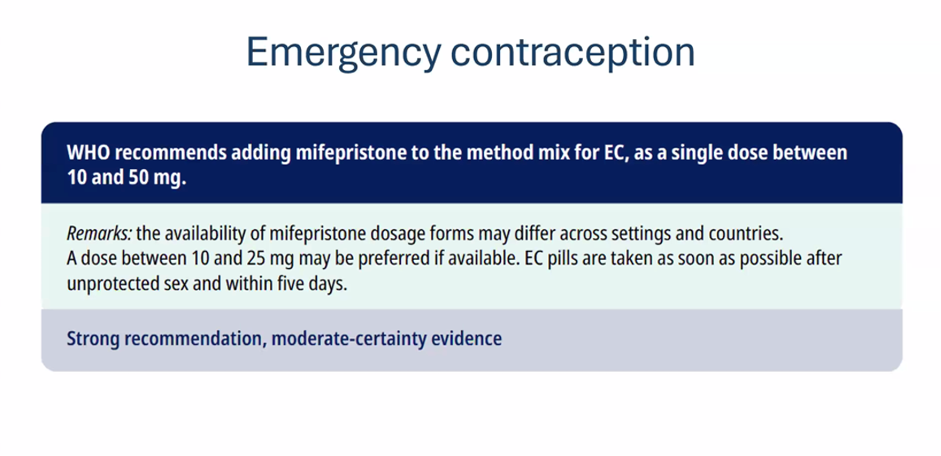
WHO recommends mifepristone as an additional emergency contraception (EC) option, taken as soon as possible and within five days of unprotected sex. Based on the available evidence, WHO states that mifepristone at doses of 10–50 mg is likely to be as safe and effective as other EC methods. A dose between 10 and 25 mg may be preferred when available. The guideline supports consideration of mifepristone EC for inclusion in national family planning programmes and clinical guidelines.

The ECO guideline (available only in English for the time being) is intended to support ministries of health, programme managers and policymakers in considering whether these methods and practices should be incorporated into national contraceptive programmes, thereby contributing to a broader contraceptive method mix.

According to ECEC data, mifepristone EC products are currently available only in China and Vietnam. These recommendations could help expand access to mifepristone EC and broaden postcoital contraceptive choices worldwide.

 
Learn more:
 
WHO Guidelines on Expanding Contraceptive Options:
WHO Guidelines on Expanding Contraceptive Options
 
Recording of the launch webinar:
https://www.youtube.com/@mediaHRP
 
WHO press release:
https://www.who.int/news/item/23-09-2026-who-expands-safe-options-for-contraception
Similar Posts

  • |

    Switzerland: a qualitative study of young women experiences obtaining EC in pharmacies 

    November 2020. Last April, Unisanté published “Remise de la contraception d’urgence en pharmacie : une étude qualitative sur l’expérience des clientes”, the report of a qualitative research exploring the opinions and perceptions of young women who obtained EC in community pharmacies in Switzerland. Individual face-to-face interviews were conducted between April and August 2019 with 30 women…

  • FIGO new statement on emergency contraception

    September 2026. The Committee on Contraception of the International Federation of Gynecology and Obstetrics (FIGO) has published a new statement on emergency contraception (EC), providing an evidence-based overview of EC methods (Cu-IUD, LNG, UPA and the Yuzpe method) and key considerations for their use. The statement, “Ensuring timely guidance on emergency contraception” reviews their mechanisms…

  • New training module on emergency contraceptive pills

    A new training module on emergency contraceptive pills is now available, in two adaptations: For clinical health care providers: www.fptraining.org/projects/emergency-contraceptive-pills-ecp For pharmacists: www.fptraining.org/projects/emergency-contraceptive-pills-ecps-training-pharmacists These modules are part of the Training Resource Package for Family Planning (TRP), a comprehensive set of materials designed to support up-to-date training on family planning and reproductive health. The TRP contains…

  • FRA releases report on violence against women in the EU

    On March 5, the European Union Agency for Fundamental Rights (FRA) is hosting a conference to launch the results of the largest violence against women survey ever undertaken in the EU.  Findings are based on interviews with 42,000 women across the 28 EU Member States and focus on women’s experiences of physical, sexual, and psychological…

  • Universal access to EC pills in Peru

    March 2023. In Peru, on March 30 the Constitutional Court finally issued its ruling regarding the case of universal access to emergency contraception (EC) pills. The Court ordered the Ministry of Health to continue providing free-of-cost LNG EC pills nationwide, through the public health network. According to the Court press release, the magistrates considered that,…

  • Argentina: New data on EC use and access

    November 2024. The Study Lucía: Uses and preferences of contraceptive methods in women aged 15 to 49 years in Argentina, was recently published. This quantitative and qualitative research has consulted 2,000 women and people identifyin as LGTB from all over the nation. The study findings, published in September 2024, include valuable information about access to…