|

Switzerland: a qualitative study of young women experiences obtaining EC in pharmacies 

November 2020. Last April, Unisanté published “Remise de la contraception d’urgence en pharmacie : une étude qualitative sur l’expérience des clientes”, the report of a qualitative research exploring the opinions and perceptions of young
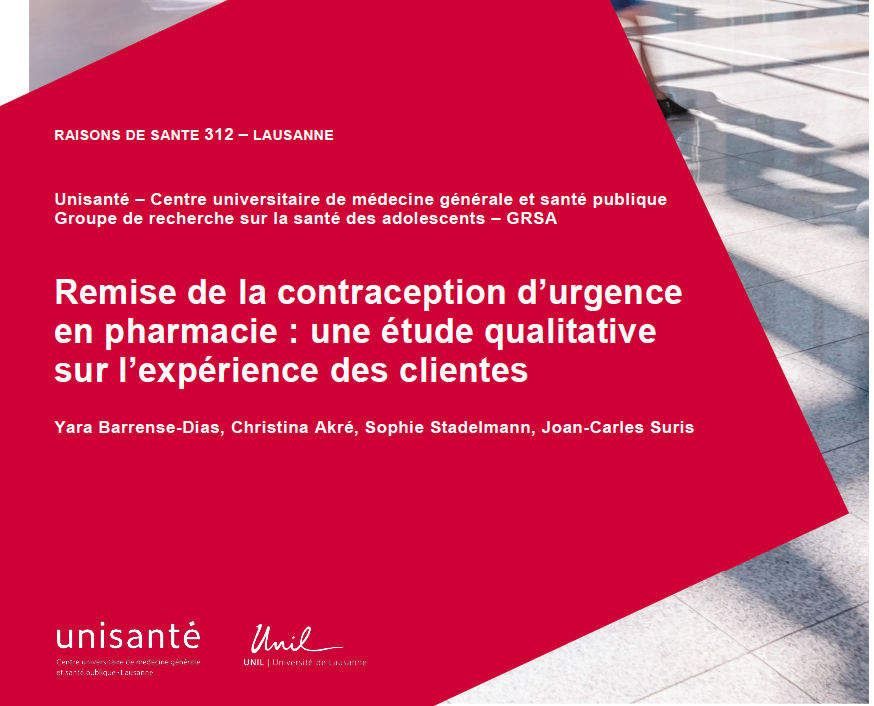
women who obtained EC in community pharmacies in Switzerland.

Individual face-to-face interviews were conducted between April and August 2019 with 30 women ages 18 and younger, who had sought EC in pharmacies in the canton of Vaud between 2014 and 2019. Issues asked included: reasons for choosing to go to a pharmacy; advantages and disadvantages; reception at the pharmacy counter; questions asked; judgments; actual in-take of the pill; price; support; contraception and prevention.

In short, the study concludes that community pharmacies are very convenient points for EC delivery. They are highly appreciated because they provide great accessibility, short waiting time, and extended hours. However, the report points at several avenues for improvement, to ensure that no barriers for young women arise in pharmacies:

  • improving the information and knowledge of young women about the procedure for dispensing EC in pharmacies;
  • improving and systematizing the information that is asked during the mandatory counseling; 
  • reducing embarrassment and prevent judgemental attitudes;
  • raising awareness among young men;
  • reconsidering the price of EC;
  • integrating pharmacists in the reflection around the delivery of EC in pharmacies.

The full document can be downloaded here and directly from our website, here

Similar Posts

  • Updated recommendation on LNG dosages and higher BMI and weights

    June 2022. Our sister organization, the American Society for Emergency Contraception (ASEC), just updated its factsheet on EC efficacy and body weight, an excellent summary of the current understanding and recommendations on this issue. This update is based on the publication by Dr. Alison Edelman and team of “Double Dosing Levonorgestrel-Based Emergency Contraception for Individuals…

  • Japan:  Trial of OTC sale of ECPs begins 

    November. According to Kyodo news agency, the trial of a new modality to dispense  emergency contraception pills (ECPs) without a prescription in Japan, began on November 28. The Health, Labour and Welfare Ministry will test out this modality in 145 pharmacies (of more than 60.000 in the country). Japan is one of the few northern hemisphere countries where…

  • ASTRA & ECEC: Tracking EC access in the region

    February 2026. The ASTRA Network and ECEC continue their collaboration to monitor access to emergency contraception across Central and Eastern Europe and Central Asia. In the latest issue of ASTRA’s Bulletin, we share findings on the discontinuation of low-dose mifepristone emergency contraceptive (EC) pills in the Russian Federation and the resulting impact on availability in…

  • Argentina: New data on EC use and access

    November 2024. The Study Lucía: Uses and preferences of contraceptive methods in women aged 15 to 49 years in Argentina, was recently published. This quantitative and qualitative research has consulted 2,000 women and people identifyin as LGTB from all over the nation. The study findings, published in September 2024, include valuable information about access to…

  • Scottish health group calls for EC in schools

    A health group in Scotland is calling on government Ministers to allow school nurses to dispense emergency contrantraception to students.  The Scottish Sexual Health Lead Clinicians Group suggests that nurses could dispense condoms and emergency contraception to school children in order to help reduce teen pregnancy rates, which have been holding steady at 7.1 per 1,000…